Saturday, February 2, 2013

Ideas for reclaiming an emergent Republic


Recently India celebrated its 64th Republic day with great pomp and show. We had marching contingents from the three wings of the armed forces as well as the police and paramilitary forces. Numerous tableaus also were displayed on the Rajpath where the President of India, Shri. Pranab Mukherjee took the salute. In the backdrop of all this celebrations we also had a series of reformative decisions taken by the government in the areas of diesel pricing, cashless transfer, hike in railway fares etc. to ease the fiscal deficit burden of the burden. Also coupled with all this was the recent spat with Pakistan over its intrusion into the LoC and beheading of an Indian soldier. Even before all this, was the gang-rape in the national capital which aroused the anger in especially the youth of the country.

Now as a citizen I am little concerned if we are just traversing from one sore incident to the other mindlessly or are we even taking cognizance of the ills in our society and taking some lessons from our mistakes. Needless to say that some of these incidents have been really shocking and have occurred for first in time in history. What are these lessons or ideas which we can embrace so that we can contribute towards nation building which unfortunately nobody seems to be bothered about these days?

Right from the Anna Hazare’s movement to Baba Ramdev’s fast at the Ramlila grounds to that of the recent protests at the footsteps of the Rashtrapati Bhavan, there have been certain common trend lines which can be observed. One that, the nation is awakening to the passivity of our decision makers. Second, the nation is unifying to the plight of the common man and thirdly, a leadership vacuum does exist, which is very much palpable in our society. I say these because today the citizens are in the mode of asking questions from the political class. They are simply not content with the rudimentary style answers or cursory assurances provided by the government. For example, in the Delhi gang-raped case instead of the action of suspension of the erring policemen the citizens wanted the amendment of the laws of the land? Citizens want a change, which is more enduring. A change which completely annihilates, such ills which exist in the society. The unrest is very much palpable and it also seems that the masses are being pushed to the brink that they are even thinking of alternative courses of action and therefore you have the Kejriwal’s Aam Admi Party and Anna Hazare’s Janatantra Morcha with burgeoning following. These are very much the signs of a possible mass social movement on the offing. Remember how the Indian freedom struggle started. Some uprisings here and there intermittently and then a fight for one unified cause woven by the emerging reach of the newspapers which at that time helped galvanize the public opinion. Today the situation is also similar. We do have such intermittent protests which have dotted our history, in the recent past. These uprisings have been assisted by the overarching spread of the social media platforms and the 24 X 7 news channels. But above all, the tragedy is that the leadership vacuum is still there unlike the pre-independent era. While Anna and Ramdev have chosen to work at the backdrop, the nation hopes against hope, for direction from the political class which is supposed to be found showing the way ahead. But the irony is that our politicians have stumbled event after event and their own credibility is coming to question, each time they try to engage with the masses. I am left wondering, do we not have a single leader at the helm who has the experience of engaging people at the grassroots and form a united front partnering with the common man and the civil society? The leaders of our freedom struggle where not like this. They were always present at the places where crisis was there. Gandhiji camped in West Bengal for days when the riots where going on to instill some calm in the people. But leaders of my generation choose to be seated in their plush offices and watch the happenings on television that come out and talk to the people.

Economically also we need to revamp our policies. Some of our actions which have been continuing in the past are highly unsustainable. The subsidy regime which encompasses even the rich, the overarching tax breaks for the big business houses are all highly arbitrary and unwelcome. The rationalizing of the diesel prices and the partial withdrawal of the subsidies on LPG beyond nine cylinders are welcome measures by the government in reducing the fiscal deficit.  The whole tax base is narrow and confusing. There is an urgent need to enhance the tax base and thereby widen the revenue streams of the government. The Railways which can be a cash cow for the government should be modernized as early as possible so as to reap the dividends of those who are ready to shell out some extra lucre to avail some comfortable and safe travel facilities. Our scientific organizations like the DRDO and ISRO should be strengthened more, so that they can not only cater to the indigenous requirements but also become sources of revenue and gradually self- reliant, by offering certain services to friendly countries. Another aspect the government needs to look into urgently is the Energy Sector. The current trend in usage of petroleum products in the country is highly unsustainable. We need to channelize our efforts to enhance the share of renewable sources of energy. Japan for example is planning to reduce its dependency on the Nuclear energy after the recent devastating earthquake which left its nuclear reactors destroyed causing emission of life threatening radiations. Japan has vowed to increase the usage of renewable sources of energy. Whereas in India, we are still trapped in the idea of relying on nuclear power to meet the energy deficits in the country. We have failed to capitalize on the excess solar power available in our nation or we can also fill up the deficit with hydro-electric project if needed, considering the fact that dams are a cause of worry for the ecosystem around.

And on the diplomacy and military front India needs to brace up to the present global challenges. In the recent past we saw how Pakistani soldiers intruded into Indian Territory and we had no option in hand to make Pakistan owe up to its dastardly act. We really have come to be taken for granted when it comes to any sort of serious diplomatic engagement. I more often feel that the fierce foreign policy which we once had during the times of Nehru has eroded now up to a great extent. For Example, under pressure from US we had to vote against our longtime ally Iran at the IAEA. China seems to be steadily asserting itself both diplomatically and militarily in the East Asian region. Their maneuvers in the South China Sea and that in the Maldives are examples for their robust policy making, backed up by its strong military capabilities. This should be an eye opener for India. India needs to recast its diplomatic policies and moreover make it more attuned with the changing times and country’s geopolitical interests. India needs to increase its influence in the Indian Ocean region for which it needs to urgently augment its naval capabilities. We also need much more advanced equipment for our ground and air forces. Having no options to exercise when provoked again and again is a sign of weakness.

I just hate it when people say we are a banana republic. I wish these aberrations which we see around us could be better tackled and if we could have some sort of mechanism in place like better legislative framework, sound political structure and better resources so that we can pursue the wholesome development story without any hiccups. Governance means all round development- development in policy making, growth in resource base, augmentation of defense capabilities, corruption free institutions. We need wholesome growth to rewrite our ‘emergent’ story.


Are our decision makers and policy makers listening!

Friday, January 18, 2013

Options in front of India viz-a viz Pakistan


Pakistan is our neighbor in the North-West. A country which was begotten out of India itself but has ever since, been at loggerheads with us .We have had a series of four wars with Pakistan in -1948, 1965, 1971 and 1999. We have defeated them decisively every time it tried to of invading India. Moreover, it has also continued to wage proxy war against us by sending terrorists across the border, majorly in J&K.


However, India as a nation has always wanted to be on a higher moral ground as far as the Indo-Pak relations are concerned. And by not retaliating vehemently it is still persisting on with maintaining on the high moral ground. The composite dialogue process is still on despite the many ceasefire violations and India believes in engaging with Pakistan on a one-on –one basis without any third party interference. More so because we haven’t had good experiences whenever we have knocked on the doors of any third party to resolve the Indo-Pak issues.  Therefore there is no alternative to a dialogue is what is a premise of the Indian policy viz-a viz Pakistan.


Now under circumstances when you have Pakistani soldiers’ crossing over the LoC and killing your soldiers as was the case on the 8th of Jan 2013, one question comes to a citizen’s mind. Is it a sign of strength or weakness to continue talking to Pakistan? The answer is that we have no better option. This limit is what Pakistan is also aware of unfortunately, and is taking advantage all the time by resorting to such provocative acts on the LoC. Therefore the need of the hour and in future will be, to develop a new set of options that could perhaps have the potential of a deterrent and have the value of inducing certain element of uncertainty in the minds of especially those who call the shots in Pakistan.

Option 1: Have a covert network inside Pakistan. This will give India more tactical elbow room which we really are in need of, during such situations. If we claim to have agencies as RAW we must well use them instead of wasting the tax payer’s money on running such agencies. Else let’s just disband them. Off late, we have come to realize one fact that having a nuclear arsenal is not the solution to the problem because Pakistan too is a nuclear state today. And using the nukes is the last option and never the first. And with India’s stance of maintaining a – ‘No first use’ policy even this option is not available. Therefore, tactical options are something we should be looking at. And as it is there is so much uncertainty in Pakistan with respect to its democratic institutions that leveraging on this chink in its armor, should not be a difficult task. Like the killing of almost 100 Shi'ites from the Hazara community recently had led to mass protests in Pakistan. Such fault lines in the populations could be used by India to destabilize it at will.

Option 2: Choke the resources to sap them economically. Indian can even think of disrupting the oil flow into the Pakistani port of Karachi. However for this India will require international support from nations like US, China and Iran. This is on the similar lines in which US wants India to limit its oil off take from Iran and instead, switch to nuclear generated plants as per provisions of the Indo-US nuclear deal. This is also true when dealing with the river water sharing. Under the Indus Water Treaty of 1960, India chose to part with almost 80% of the water of the six Indus Rivers. As we have built dams on these rivers on the upstream on our side we can regulate the flow of water and choke the agrarian economy of the Northern parts of Pakistan. I feel we have been too generous with Pakistan and it’s time to tighten the noose. With all these rivers flowing from India and then to Pakistan it gives us enough room to ensure that the agricultural land across the border remains parched.


Option 3: Raise a diplomatic offensive to isolate Pakistan internationally and stop foreign aid from flowing in. Since 2001 $20 billion has been doled out by the US alone to Pakistan in the form of civil and military aid largely for using the Pakistani air bases and for allowing a free hand for the CIA to operate inside Pakistan. After the US operations in Afghanistan wound up by this year end, India must ensure that this aid reduces considerably and is gradually stopped at the earliest. Also we must see that no military hardware is traded between US and Pakistan so that these are not used by Pakistan against us in the event of escalations in tensions, if any.

Option 4: Deploy troops in Afghanistan. Undoubtedly India has spent a lot of money in the aid for Afghanistan and which Pakistan has been uncomfortable about. When US troops leave Afghanistan later this year, India can think of deploying a lean contingent of our special forces so that it has some sort of deterrent value and also a spoiler in terms of their focus on their border with India. A hot Durand line is in the interest of India as circumstances stand at present. This should sap the energy and resources of the Pakistani army slowly.

Option 5: Develop better relation with China. This is the most uphill task but also has the potential of being the most enduring one. A neutral approach of Beijing can be the best antidote to any Pakistani misadventures in the region. Given that China has invested in Pakistan it is a challenge to make Beijing act against Pakistan but what we can possibly do is to equally checkmate China in the process by increasing the presence on the Strait of Malacca from where the crude oil supplies flow to China.

I am not saying that these are easy options, perhaps not. To put in place some of these options India will require considerable political will and deft diplomatic and administrative acumen. But I strongly feel, time necessitates that we think in these directions. Else we run the danger of Pakistan bleeding us militarily and politically by engaging in such provocative acts as the crossing of the Pakistani troops into India in the Mendhar sector on the 8th of January this year, and we having no option but just harp that- we have to engage in dialogue, and that too when we don’t even know if we have a buy in from the other side or there are sufficient mutual trust between both parties.

We have seen in the past that governments after government have been sitting as lame ducks whenever Pakistan has acted in such a manner. Take the example of the IC-814 hijack or the attack on the Indian Parliament or the 26/11 attacks on Mumbai. You even had the NDA government which even marched a million men to the border and back, thinking that, that was an option, when it was not really. This kind of thought process is necessary if India has to be aregional power at least, forget being a super power.

Sunday, January 13, 2013

A case for the urgent modernization of the Indian Railways


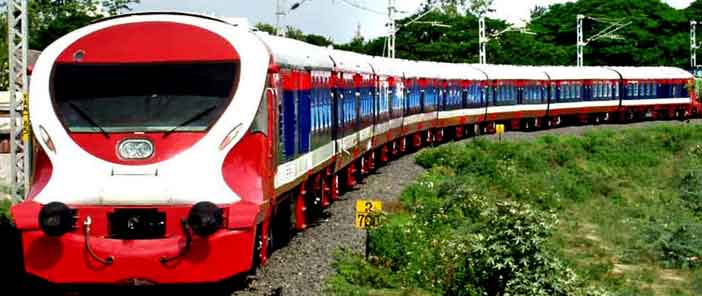
Recently, it was in the news that China opened a stretch of 2,298 kilometers long, high speed railway corridor from the country's capital, Beijing in the north to Guangzhou. China tops the world in having an expansive High Speed Railway network which operates at an average speed of 200 km/h or higher. And as compared to this- is our railways which still runs at average speed of 60 km/hr, operates the same old archaic coaches which are of minimum comfort. And if you have got berth near the stinking toilets then rest assured that your whole journey is going to be miserable and bound to leave an indelible mark in your mind for ever. Well, travelling is supposed to be pleasure but no longer is this true if you are travelling by the Indian railways.  And the next time around you do a booking you will definitely be prompted to at least check out the air fares, even if you cannot afford to book. This is the current situation of the Indian Railways which is the largest employer in India today. The same railways in which, we take proud because it is the lifeline of our nation, connecting its lengths and breaths. Moreover, railways have been a boon to the common man who can travel at relatively economical fares, at subsidized rates.

Remember that the Indian Railways is a legacy of the British raj. Post independence there is not much that has changed for the Indian Railways. There may be some milestones which the railways have traversed. As far as I can recollect these are- the change from steam to diesel/electric locomotives, switch from narrow/meter gauge to broad gauge and construction of the Konkan stretch. But In terms of speed and safety it has not recorded much progress, as compared to that of the British times.

Unfortunately the picture is not all that rosy today. The railways are cash strapped and are having losses at almost whopping 25,000 crores. The speeds of trains are below than any benchmark as per the 21st century standards and the amenities are abysmal, if not worse. Added to all these are other problems like the requirement to make well in advance bookings, overcrowded unreserved compartments, unhygienic food, littered platforms, and security issues especially for ladies and the like. With cross subsidization the freight fares are increasing thereby making the railways less cost competitive as compared to the transport companies operating trucks. Thus, the railways seem to be heading to slow doom, which is almost the writing on the wall, unless we take some drastic measures to salvage this poster boy of Indian transport landscape.

However with the recent decision of the government there is some hope that the losses suffered by the railways would somewhat get reversed by the marginal price hike. The political parties are making a hue and cry of the price rise, saying that it will put undue burden on the common man. But this argument is false in my opinion. The price rise is marginal. If the fare from New Delhi-Mumbai was earlier Rs. 388/- then now it is Rs. 465/-. Which is an increase of Rs. 73/- which I believe is affordable when such long distance journeys are made once or twice a year.  And in any case the rise in fare in the sub urban segment is only 2 paisa.

And above all, we cannot be left behind as far as modernization of the railways is concerned. Railways is a key lever to the economic growth of any region. Connecting the under developed regions of the country with that of the developed regions can bring more economic parity. Railways has the potential to accelerate the movement of goods and people across the trade centers. Now the question arises how do we achieve this? The answer is to augment the speed of the trains by building High Speed Rail networks. HSR has a lot many advantages. Firstly, moving passengers through high speed lines frees up older railways to carry more freight, which is more profitable for railways than passengers, whose fares are subsidized. Secondly, this would also mean less clogged national highways and also reduced consumption of diesel whose import is a great drag on the national exchequer. Thirdly, dedicated High-speed railway networks allow more trains to share the tracks and this can be achieved at higher speeds. Fourthly, HSR construction would create jobs and drive-up demand for construction, steel and cement industries during the economic downturn. For example, Work on the Beijing-Shanghai HSR mobilized 110,000 workers. Fifthly, HSR locomotives being electric are more environment friendly. Lastly, developing an indigenous high-speed rail equipment industry make you being able to sell high-speed rail building technology to other nations are thereby early revenue as in the case of Antrix cooperation of the ISRO which helps launching of satellites for other nations. However, one must remember that the Chinese went for the policy decision of the modernization of its railways as early as in 1994. And subsequently it made what is visible, as a steady progress in stages. From 1997 to 2007, the speed of China's railways increased six times. Therefore the point here is that any plan of transformation and more so for the Indian Railways which is a mammoth machinery by itself, would take substantial amount of time to bring results. Therefore the key is to begin early so that the Railways stays in business else there is all danger of being kicked out of the scene by the low cost airlines and transport companies.

 If you have been to New Delhi, and the New Delhi metro station, you would feel how advanced and commuter friendly it is. But as you walk out of this underground station and move towards the New Delhi railway station of the Indian Railways you would witness something which is contrary to what you observed a few minutes back. You would see diesel locomotives pulling the age old model of coaches overcrowded with passengers and of course with the iconic stinking toilets. The theory of ‘Two India’s’ comes alive in front of you. As Indians we have the opportunity to bridge this gap. We can support the proposed hike in the railway fare. Thereby do a favour for posterity so that at least they don’t come to realize this gap. And that our next generation inherits a much safer, faster and efficient Indian Railways. This will be the best service we can do for our coming generations. Else history would adjudge us with inaction, when we were cognizant of the dwindling condition of the Indian Railways, leading to a downward spiral. Undoubtedly the railways may have chosen to burden the common man with the recent price hike, but the real test for railways is to convert the additional resources garnered, to tangible changes on the ground, in terms of better safety, amenities and modernization, so that the trust of the common man continues in the Indian Railways.


Sunday, January 6, 2013

Why we need our uniformed personnel to be protected more?


Recently the nation witnessed the tragic death of a Delhi Police Constable, Subhash Tomar. Constable Tomar was seriously injured while controlling the protesters at the India Gate who were demonstrating against the recent gang rape in Delhi. He was rushed to hospital in an unconscious state and was kept on ventilator before he died on 18th December, 2012 after battling for his life for two days. He is survived by his wife, two daughters and a son.  This is yet another example of the ultimate sacrifice made by our men in uniform irrespective of its color. Be it olive green, khaki, black, white or blue, our men from the armed forces, police and other paramilitary forces have proved numerous times  that when it is the question of defending the territorial integrity of our nation or, that of maintenance of law and order, they are most dependable.

Now what is painful is that, everybody is talking of the brave lady who lost her life after she was brutally raped but Constable Tomar has soon become a forgotten hero, and nobody is talking about the sacrifice that he made and that of his family. Does donning the uniform mean that there is no value of your life or does it mean that it what you are supposed to do as part of your duty because that’s what you get paid for? Isn’t the life of a jawan or a policeman of this country as precious as that of any other citizen?    


I believe that the death of Constable Tomar was avoidable. While there are contradictory reports as to whether the constable really died controlling the mob or due to any personal ailment like heart attack. While we debate this and the investigations are on what can be said for sure and with utmost conviction is that, no proper first aid or ambulance was available in expectation of any emergency, when you had a situation where in hundreds where descending to the India Gate and clashing with the police. The visuals of the clashes showed that the policemen were largely in their plain khakhi outfits devoid of any helmets or bullet proof jackets, except some. When will we understand behind these men in uniform, are also their families and children. As a nation-state of the 21st century, we are duty bound to defend and protect those who protect the territorial integrity and defend the law and order within. Because the maintenance of ‘law and order’ and protection of the territorial integrity, is what is innate to the very concept of nation –state and those who defend it should be treated with utmost regard.

From the point of view of the Army also we know that during the regular operations in the Siachen Glacier last month we lost 6 soldiers to an avalanche. I am not saying that these casualties could be prevented, may be not. When nature’s fury is at its maximum at places like Siachen, there is a lot of   uncertainty bound to prevail. Nevertheless what we can do at least that we can set up some mechanism which goes down into the causes of each of these incidents and tries to mitigate its occurrence in future. Else such casualties will keep taking place. The price of a jawan is not only precious for the forces but also we are accountable for his safety, to his family and next of kith and kin. Even in low intensity warfare in the hinterland as per the Annual Report of the Ministry of Defense of 2012 for the 95 terrorist killed and 35 apprehended, while we lost 15 soldiers. 530 soldiers were martyred during Kargil war under Operation Vijay. But 3,987 soldiers have been killed afterwards during the years 2000-2012. This makes an average of 330 soldiers per year.


Apart from this a total of 394 Army personnel have committed suicide between 2009 up to November, 2012. The case of an Army man who spent five days atop a mobile phone tower in the heart of Delhi to highlight his grievances — he threatened to jump but was somehow brought down safely — seemed to epitomize the crisis. Incidents of ‘fragging,’ or the fratricidal killing of fellow soldiers or superiors, also continue. It is clear that measures that were put in place by the armed forces after a study done by the Defence Institute of Psychological Research to identify stress-points are not efficacious enough. Some senior officers have contended that more than the physical and mental strain that extended deployment in counter-insurgency roles exerts, domestic, family and financial problems account for much of the distress.

Take the example of the Indian Air force. As per statistics the Air force has lost 171 pilots in crashes involving the Russian-origin MiG series of fighter planes in the past 41 years. The IAF had purchased 872 MiG aircraft of various types between 1966 and 1980. Out of these, 482 met with accidents between the financial year 1971-72 and April 19 2012. This makes an average, one pilot was killed in a MiG crash every three months. This is the state of Air Defense in our country. Imagine the morale of the pilots behind these machines which have far exceeded their service life but their replacement have not yet taken place. No wonder the MIG-21s came to be called as ‘Flying coffins’.

Now what the armed forces requires is a multi-pronged strategy at multiple levels in order to arrest these alarming trends. First, convert the peace areas to full-fledged family stations even for the jawans. This will allow the jawans to withdraw their families of from their ancestral places and keep them stationed in the Cantonments. This is more secure, gives adequate facilities, and ensures that children’s studies are unhampered and that they have other families around, who are in a similar situation, to empathize or provide the necessary support. Today, out of the 17 years that a jawan puts in as service he may be able to keep his family with him may be for just 3-4 years. This arrangement is absolutely skewed and is a certain drag on his mental makeup. Government has to ensure that the family life of jawans also remain undisturbed, as is the case with officers who are able to keep their families throughout except in field areas. The breakup of the joint family system has made the situation for the jawans even more problematic. Nuclear families have to fend for themselves now. And these stresses, within their families, even if they are miles away, get transmitted rapidly because of mobile phones, on a day to day basis, aggravating his stress levels furthermore.

Secondly, having a better pay parity is another aspect which is of utmost importance. Today the comparison is made with the private sector where the salaries are higher and there is a better quality of life. A poor economic situation can easily lead to lowering of the morale. There has to be a better parity between the officers and the jawans. The risk that the take are alike only the responsibilities differ and therefore one cannot be paying the jawans 1/10 of what is paid to the officers.

Thirdly, retirement and reemployment of the Jawans is another critical area. Imagine that you have to retire at the age of 37 yr. Will it not call for anxiety when at the peak of your life you are faced with the fact of retirement which could be aggravated by the fact that your children are still at school. And financial liabilities are all the more. I for one thing, am for the extension of the retirement age for jawans. Why do we want to lose these experienced soldiers so early in whom we have invested so much. And even if we provide their early retirement, what are we doing to get them suitably reemployed elsewhere. I strongly feel that there has to a centralized repository of database of organizations which could absorb these jawans and make the transition much easier. At least they could also be absorbed into the many auxiliary arms of the armed forces itself like the Defense Accounts or Defense Estates, etc.

Fourthly, provide all forces with the best possible equipment and intelligence before any sort of engagement. We heard that during the 26/11 attacks on Mumbai how we lost so many policemen due to inadequate bullet proof vests. Spending of a few lakhs could save umpteen lives. The decision makers must understand that showing generosity in terms of distributing compensation, to a martyr’s family is of less meaning when the family feels that the sacrifice could have been avoided. The defense equipment acquisition process should be both streamlined and expedited. If required the Planning Commission should be made in charge of planning the defense needs of the nation along with that of the economic development so that we do not land up in a situation where we are not able to defend our economic interests domestically and abroad alike, with , minimum casualties.

This is the minimum we could do for those who give the best years of their lives, in the service of the nation. You need motivated men with advanced weapons to make a 21st century Armed forces which is capable of striking hard and striking deep. With a defense budget (2012-13) of Rs.1,93,407 crore, of which Rs.1,13,828.66 crore (58.85%) is earmarked for revenue expenditure,  there is some optimism that our men in uniform (Army, Navy, air Force) will get a fair deal in the years to come, if this trend in expenditure continues for a while. For no excuse or compensation, upon the loss of a life of a soldier or policeman, on account of a poor strategy, misjudgment or under equipment especially during peacetime, is justifiable. For this is no reason that even the family of the deceased soldier can take pride in, and if that is so, a nation should certainly not.  

Sunday, December 23, 2012

Slicing and dicing the recent rape in the capital


On the night of 16th of December 2012, a 23 year old woman was brutally raped in a moving bus in the heart of our capital by six men. Then they threw her out on the road and fled. The Delhi Police cracked the case in the next 24 hours and took five of the six accused into its custody. As I write, the whole nation is enraged by the fact that this particular rape was done in the most brutal manner that the survivor had to be put on ventilator for the next few days and is even now in a critical condition. The physical and emotional violation which took place was barbaric and abhor able and the common man of this country is once again on the streets asking that justice be delivered at the earliest.

As before, and now again, the systemic failures within the government are coming out strikingly in public gaze. The Delhi government washed its hands saying that the Delhi Police is not under it, but comes under the Union Home Ministry so its hands are tied. The Union Home Ministry did step into the scene and elaborated on the measures it has taken and are going to take to prevent recurrence of such incidents. But my question is –Isn’t this a mockery of the trust of Delhites who through voting have elected a legitimate government but this government is not empowered to ensure their security. They are actually looked after by the Union government as the Delhi Police come directly under the Union Home Ministry. This is absolutely unreasonable and illogical. And what accountability does the Union Home Ministry have anyways, to ensure that Delhi‘s three crore citizens are safe, when they are not the real representatives of the Delhites. It is high time that we put the Delhi Police under the Delhi Government so that it looks into law and order situation than guarding the various ministers and VIPs of the Central government. The Union Government anyways has umpteen numbers of Central Paramilitary forces under them which they can utilize in case of any exigency. And in situations of conflicting opinions the Union Ministry could be vested with overriding powers over the Delhi Government.

The Union government has fared no better in discharging its duties, so far at least. To pacify the irate protesters at the Raisina Hill who were demanding that justice be done at the earliest, the union government had flimsy solutions like extending death penalty to cases of rape, immediate suspension of the beat constables who were in charge of the area where the rape took place and some others. As a matter of fact death penalty is already in the statutes and does get invoked in the rarest of the rare cases irrespective of the matter whether it is a rape or not. In fact the person to be hanged before Ajmal Kasab, Dhanajoy Chatterjee was found guilty for raping and murdering a 13 year old minor. Not only this, they have failed miserably to engage with the protestors. No minister was seen at the scene engaging or at least listening to the demands of the people. And it is only this apathy which got shown and lead to the protesters breaking the barricades at the foot of the North and South Blocks in the evening of 22nd December, and clashed with the police. Why is this government always reactive and why it cannot be proactive in such instances is my question as a common citizen of this country. Look at the Obama administration. After the shootout at Newtown, Connecticut the way it engaged with the people was quite mature and healing. Soon after the unfortunate disaster took place, the President made a statement and later also attended the memorial service and then he came on television to propose and seek support for the steps he plans to take in controlling the misuse of guns. A brief outline of the plan was provided and even the timeline was set for January. All this show some seriousness of the Obama administration in dealing with the issue at hand. These are the ways in which the government of the day can reassure its constituents. Not by huddling up inside their plush offices and then showing up in Press Conferences with all the more illogical and tardy solutions like establishing a judicial commission to look into crimes against women. Can the government of the day win the trust of the masses in such immature and sluggish ways? This government is like a tortoise. When situations are hostile its head is always inside the shell and only during election does it come out.


Coming to the societal aspect of rape, I am so bemused to find elements in our own society who can do such dastardly act to a woman. It seems to me that the moral fabric of our society is under severe strain and the collective conscious has shrunk terribly. And there are telling facts which convey this. As per the data served by the National Crime Records Bureau, in 1971 there were 2,487 cases of rape which were reported in India and in 2011 there were 24,206 rape cases which were reported. Almost 870 % increase in rape incidents. Now this does call for some introspection. When the nation is developing the crimes against women and especially the heinous ones as rape is on the rise. Also there is data which makes us believe that not only a vast majority of these cases have survivors who were in age group of 18-30 years but also that the majority of the perpetrators of these crimes have been neighbors. These are some inferences which can be drawn. Now this is really discomforting. We usually tend to rely on our neighbors for help in times of need. The Bible says-“Love thy neighbor as yourself”. And it also commands that “You shall not covet your neighbor's house; you shall not covet your neighbor's wife, or his male servant, or his female servant, or his ox, or his donkey, or anything that is your neighbor's”. And if our daughters are not safe even within the precincts of our own immediate neighborhood then it’s a matter of grave concern.

Ironically even literate states like Kerala are high on rape and cases of incest. You cannot be treating half of the population like thrash and still have a healthy society. The recent cases of incest which have come to light especially in Kerala are also of grave importance in this context and indicate the fact that our families have become dysfunctional at the first instance. As ‘family’ is the foundation for primary socialization for any individual in his or her formative early years if there is a virulent strain within our families then there is all certainty that this would infest the society also, and that to in an amplified form. And therefore incest magnifies and becomes rape when it transcends the limits of family to that of the larger society.

Our society needs a course correction now at least. Moral education is missing today from the school curriculums. The whole syllabus has become entrance exams oriented. As long as the syllabus is catering to these exams, parents also are not bothered. Because for them, what is important, is their child’s future with regard to his or her better employability. Whether he becomes a responsible citizen of the country or not, is secondary. If a society has to be functional then they has to be an agreed code of conduct. And having a uniform curriculum is one way of achieving this. We can only inculcate right values during the formative years of a child. Once he is out of school, professional studies take precedence over other things. Under such circumstances an overhaul of the school curriculum is the need of the hour. We need to have lessons imparted to the next generation on values of tolerance and teach them to practice respect towards women, in all walks of their life.

We are living in an anomic situation today wherein such social ills exist. But once these corrective actions take root in the society the change would be visible. But for such a change to happen and its fruits seen in our lifetime what we need is concerted action. We need action from those in politics, education, and civil society and above all, from us, the citizens of this nation.   


Thursday, December 20, 2012

Are we better off with the execution of Kasab


The 21th November, 2012 news read that one of the ten terrorists who was part of the 26/11 carnage in the city of Mumbai and the only one to have been captured alive, Mohammad Ajmal Aamir Kasab was executed at the Yerwada jail in Pune. Kasab and his fellow terrorists were involved the loss of 166 lives over the next three days after 26/11 until the security forces neutralized them in a surgical operation conducted by the National Security Guards. Of the dead were military personnel, police officers, foreign nationals and ordinary Indian citizens.  The city of Mumbai was scared forever from the tragic turn of events.
A special trial court was setup to hear the case. The defence lawyers changed many times due to various reasons. Finally the special court gave its verdict on 6th May, 2010 awarding capital punishment to Kasab. This was challenged at the Bombay High Court which upheld the judgment of the trial court. And later Kasab moved to  the Supreme Court which also upheld the death penalty to Kasab in its judgment dated 29th August, 2012. Even the last option, the one that of submitting a mercy plea to the President of India was invoked for Kasab. The President as per constitution has to act on the advice of the Council of Ministers (Art. 72) and once the Home Ministry also rejected the petition, the President gave his consent and the execution followed.

Now what was interesting is that our politicians across party lines were quick to gather some brownie points from the whole episode. Some said, this is the victory of India, others termed it as honoring the wishes of the Indians and still others said that this would send a strong message to our neighbor. But my argument is a simple one. What is the result we are trying to achieve by executing the one who had anyways embarked on the journey to India as part of a ‘fidayeen’ squad, and was anyways prepared to die on 26/11 itself at the first place. In retrospect the execution of Kasab I feel was just mere tokenism on part of the government? And what was more interesting that the principal opposition party was quick to jump on the bandwagon and rake up the issue of Afzal Guru, the one found guilty of the attack on the Parliament in 2001, and demand his execution too. Look what politics and political parties have stooped to, in our times. In the absence of any clear ideological backbone they have reduced to using death convicts as crutches for survival and sustenance of their appeal among the masses.

On the sidelines of preparation of the execution of Kasab there was a the debate unfolding in the UN General Assembly on the 19th Nov,2012 on having a moratorium on capital punishments in the world. In this debate India voted against having any such moratorium. Altogether 110 countries voted for the motion i.e. to have a moratorium, and 39 were against it. India was among Iran, Egypt, Pakistan, Saudi Arabia, China, Japan, Singapore and the US who all voted against the motion. Now I have a slight discomfort with this. Though in India, the actual figures of executions are far less, as compared to that of countries like China and Iran. The previous execution was carried out in India in 2004, when India hanged a man convicted of raping and murdering a 14-year-old girl in 1990. But still is it befitting for a nation like ours which espouses the beliefs of non-violence and ‘satyagraha’, to be found in such a club of nations. I certainly feel that all the Gandhian principles and philosophies of our founding fathers have gone for a toss. Are our actions as a nation in consonance with the long cherished values of peace and non-violence espoused by them?
Nevertheless there is a silver lining among the dark clouds. One has to compliment the Indian judiciary which persisted four years to take the case to its logical conclusion. Our judicial framework provided the best possible legal arrangements for Kasab from having a lawyer to submitting a mercy plea to the President. The entire gamut of options was exercised. This should re-affirm our faith in the legal framework of our nation which grants all, the right to explain and place before the court her or her side of the story, even if it’s a non-citizen terrorist like Kasab. And as far as long as death penalty is concerned as long as this option is available in our statutes it would continue to get invoked in the “rarest of the rare cases” as was this one.

Now the prime issue here is not of Kasab who, as the honorable Supreme Court noted, never showed any sign of remorse or repentance throughout his prosecution and therefore his rehabilitation was ruled out by the apex court itself. But I have a larger point to make here. Kasab in his confessions clearly stated that he came from an impoverished family and was lured into joining the ‘jihadists’ for money and for leading a decent life. Kasab was illiterate as his lawyers have pointed out that he knew to neither read nor write. He even spent some time working as a daily wage laborer before joining the LeT. The story of Ajmal Kasab corroborates the fact that poverty, illiteracy and unemployment are the greatest scourges in any society.  And with these issues looming large in our own society can India really claim victory from the execution of Kasab? Executing someone who was already been put behind the bars or had already decided to die several years’ earlier, serves little purpose. I understand that no amount of words or actions are enough to console the ones who lost their loved ones in the shootout in the wee hours of November 26, 2008 in Mumbai and the kith and kin of our security personnel who fought to free Mumbai from the clutches of terrorists. Especially the courageous act of Tukaram Ombale, the valiant police officer who laid down his life which led to the capture of Kasab, will always remain etched in golden letters in the history of our country. But one thing is sure. Unless we get our act together and fight the ills in our society we would be no better than the society which Mohammad Ajmal Aamir Kasab came from. Therefore the question remains are we really better off with the execution of Kasab?

Lessons for Shiv Sena and Indian Politics


Bal Thackeray may have been the epitome of divisive politics in the country, as has been portrayed by at his demise. But one cannot deny the fact that his following especially in Maharashtra has been mammoth.

I presume the theory of - ‘bhumiputra’ or ‘sons of the soil’ as propagated by Bal Thackeray, was a result of his, not so good experience during his early life when he was  a mere political cartoonist in one of the English dailies. His cartoons lampooned the Congress governments of the day and flayed their policies and painted them as anti-marathi. Over time his ideas, through his cartoons started finding favor with the Marathi ‘manoos’.  Later he started his own cartoon weekly called ‘Marmik’ and subsequently in 1966, once his following had reached the required critical mass, founded the Shiv Sena at the Shivaji Park, the same ground where his funeral pyre was consigned to flames. By virtue of pure rhetoric and good public speaking skills he managed to galvanize the opinion of masses that would swear by his ideology and could go any extend to follow his dictates, in letter and spirit. No wonder in 1995 Shiv Sena secured 73 seats of the 288 seats in the Maharashtra Legislative Assembly. This has been the best performance of the Shiv Sena till date. And later in 1996 it sent 15 Members of Parliament to the Lok Sabha of the 48 seats in Maharashtra.


Now that’s the beauty of the Indian Politics. You can reach the citadel of Indian Democracy- The Parliament, with the help of a sub – national ideology. Only pre-condition is that you should have the numbers on your side. People who would buy-in to your kind of ideology. Example is the BJP, which had secured just two parliamentary seats in 1984 general election and later under the ‘Ramjanmabhoomi Mandir’  banner was catapulted to become the ruling party (under NDA coalition of course) of the country between 1998-2004. But has since faded to being the opposition, with the retirement of Atal Behari Vajpayee. Similarly Shiv Sena also stands at cross roads today. There is very little optimism that BT’s son Uddhav Thackeray, will be able to fit into the shoes of his father, who by all means had a larger than life image in the Indian political diaspora.

I have just two recommendations for Shiva Sena. First, try to have a more inclusive in terms of the ideology. Over the past elections, data shows that Shiv Sena has steadily been losing its ground. In 1999 the seats it won were 69, in 2004 it stood at 62 and in 2009 it again fell to 45. Now this calls for some introspection. Second, get your act together and ensure that your leadership is able and has a futuristic vision. Charismatic movements have the danger of being short lived. It is driven by the charisma of the leader in most of the cases. With BT demise Shiv Sena is likely to face struggle, as has been the case with Azad Hind Fauj after Netaji.

If you watched the US presidential election debates you would realize on how progressive the ideas on which elections are fought, are. Healthcare, jobs, taxes, friendly environment for small business and education loans are the substantive issues on which votes are garnered. Even in the US there are a host of communities like African Americans, Hispanics, Jewish Americans, Arab American and Asian Americans. But in US politics one would rarely be able to find the strains of communalism or policy of appeasement to that of any sub-national identity today, at least not overtly.

As an Indian sometimes it occurs to me whether in our country such mature politics would ever find place. Perhaps American democracy has matured over time (since 1787) and we are still in the nascent stages of growth. But my only contention is one. Can poverty and illiteracy wait for the dawning of sense and statesmanship in our politicians?